
Why auditors focus on IFRS share-based payments
An IFRS audit readiness checklist for share-based payments helps finance teams prove that valuations, expense recognition and disclosures are complete, supportable and consistent across IFRS 2, IAS 12, IAS 33 and related requirements. It turns a high-risk, judgement-heavy area into a repeatable process your auditors can quickly test.
Share-based payments touch executive pay, tax, EPS and employee data, so auditors treat them as a sensitive area. Standards such as IFRS 2 and IAS 33 require detailed calculations and narrative disclosures that are easy to get wrong. KPMG notes that the complexity of modern equity plans and frequent modifications are a major source of audit issues in practice (KPMG IFRS 2 handbook).
Common pain points include missing valuation reports, undocumented performance assumptions, inconsistent leaver treatment and gaps between the numbers in the financial statements and the equity registers maintained by HR. Your checklist should be designed to eliminate these gaps before the auditors arrive.
Practical IFRS audit readiness checklist for equity awards
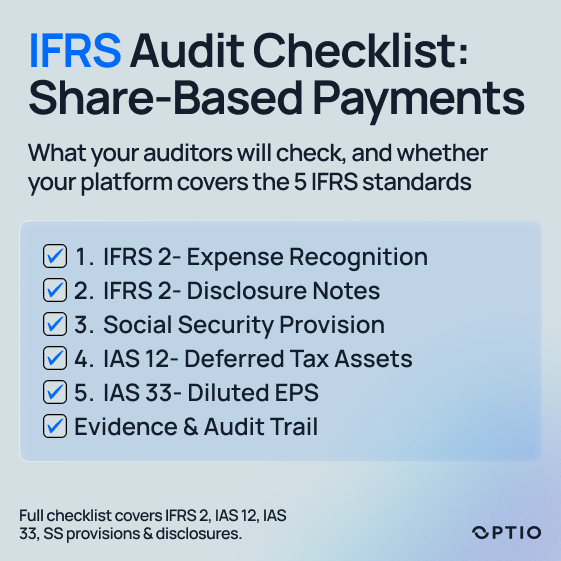
An effective IFRS audit readiness checklist for equity awards starts with IFRS 2 expense recognition. Confirm that forfeiture rates reflect current leaver trends, valuation reports are signed and retained, and fair values for new grants use appropriate models such as Black-Scholes or Monte Carlo, depending on plan design.
Next, review any performance conditions. For non-market performance metrics, document the latest estimate of likelihood of achievement, who assessed it, when, and on what basis. For market-based conditions, confirm that the total IFRS 2 expense has not been reversed or adjusted, a common misinterpretation highlighted in technical guidance from firms such as ICAEW (ICAEW IFRS 2 summary).
Finally, check all vesting schedules and any plan modifications. Complex graded or time-plus-performance vesting must be modelled correctly by tranche, and any repricing or extension requires calculation and separate recognition of incremental fair value. Walk through the checklist line-by-line against your latest period to identify gaps.
Building evidence, controls and audit trail for IFRS compliance
Auditors do not just test outcomes; they test evidence and audit trail. For each equity plan, you need a clear line from source documents, board approvals, grant agreements and cap table extracts, to the data feeding your IFRS calculations and disclosures. Every assumption that involves judgement should be explicitly documented.
Start by mapping each data source to the relevant report: IFRS 2 expense tables, movement reconciliations, tax and social security provisions, and diluted EPS. For each, capture the FX rate source, the process for classifying good and bad leavers, and how performance outcomes are approved. Ensure that HR records support each individual leaver classification and that any changes are time-stamped.
Strong internal controls make the audit smoother. Examples include a quarterly review of new grants and leavers by both Finance and HR, documented sign-off on key assumptions such as volatility and expected life, and version control for every set of calculation outputs. This reduces the risk of last-minute restatements when auditors find inconsistencies.
Getting IFRS 2 expense and disclosures right first time
To be IFRS 2 audit-ready, start with a reconciliation mindset. Your movement tables must bridge opening to closing outstanding instruments, granted, exercised, forfeited and expired, and tie exactly to your underlying registers. Any delta between the disclosure note and the calculation model will be challenged by auditors.
Ensure that all valuation assumptions are captured and stored per plan: volatility, risk-free rate, expected term and dividend yield. External sources for inputs, such as risk-free curves or peer-group volatility data, should be referenced and retained. As one public guide to IFRS 2 notes, the standard's objective is to capture the full fair value of employee services in the financial statements (EquityList IFRS 2 guide).
For complex vesting schedules, confirm that expense recognition follows the correct tranche approach over the vesting period. Where plans have been modified, calculate incremental fair value using before-and-after valuations at the modification date and recognise this separately from the original grant cost. Build these checks into your quarterly close rather than waiting for year-end.
Handling tax, social security and diluted EPS under IFRS
IFRS audit readiness extends beyond IFRS 2. You also need robust processes for social security provision, deferred tax and diluted EPS. For social security, identify all awards subject to employer charges by jurisdiction, verify current contribution rates, and re-measure the provision at each reporting date using up-to-date share prices.
Under IAS 12, calculate deferred tax assets on temporary differences arising from share-based payments, using current corporate tax rates per country. Document your recoverability assessment clearly, recognising DTAs only where utilisation is probable. For diluted EPS under IAS 33, apply the treasury share method, remove anti-dilutive instruments, and ensure performance conditions are tested as of the reporting date, not only at the end of the performance period.
Because tax rules and social charges change frequently, schedule an annual review of rates and thresholds with local advisers. Capture the date and source of each update so auditors can see why specific assumptions were applied.
When to move from spreadsheets to a specialist IFRS platform
Many companies start by managing share-based payment accounting in spreadsheets. As plans grow in size, complexity and geography, this quickly becomes a bottleneck and a source of audit findings. Being truly IFRS audit-ready often means moving to a specialist platform that centralises data and automates the most error-prone steps.
Consider transition when you operate in multiple jurisdictions, run several plan types, or face frequent modifications and performance assessments. A fit-for-purpose system should produce IFRS 2 expense and disclosure reports, social security provisions, IAS 12 deferred tax calculations and IAS 33 diluted EPS, all using consistent underlying data and clearly documented assumptions.
The goal is a single source of truth, not another layer to reconcile. When your platform maintains an end-to-end audit trail, from grant approval to final journal entry, audit cycles become more predictable and less dependent on fragile spreadsheet models.
Most platforms don't cover all five IFRS standards.
Check if you are covered.

 The Optio Team