

The 2026 DACH long-term incentive benchmarking report from Optio and HCM is now available to download. It benchmarks LTI design at 393 listed companies in Germany, Switzerland and Austria, and shows what participants do once their awards vest.
Download the 2026 DACH LTI benchmarking report
What is the DACH LTI benchmarking report?
Granted but not given: Understanding the complete lifecycle of long-term incentives in listed DACH companies is a joint study from Optio and HCM. In short:
- Who produced it: HCM led the market analysis. Optio contributed the analysis of post-vesting behaviour.
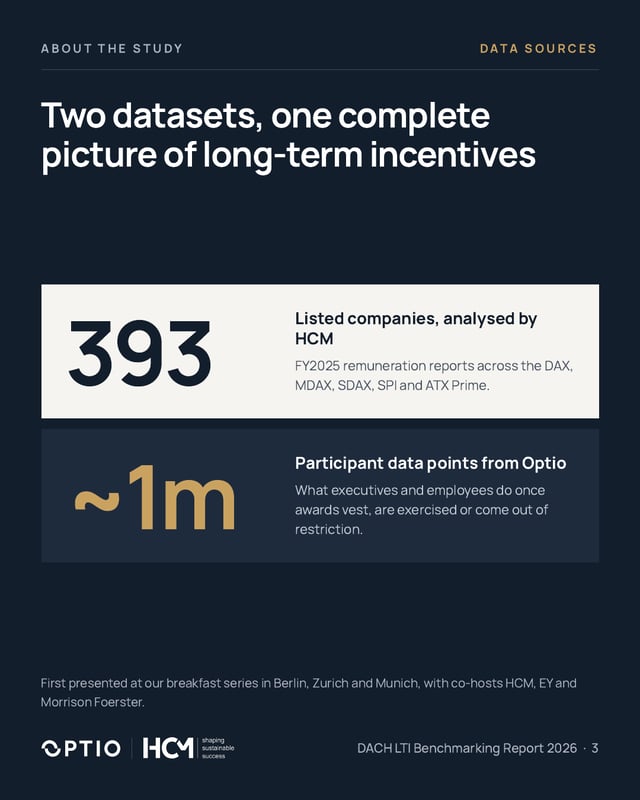
- What it covers: FY2025 remuneration reports from 393 listed companies across the DAX, MDAX, SDAX, SPI and ATX Prime.
- What it adds: around 1 million participant data points from Optio, showing what happens after awards vest.
- How long it is: 60 pages.
- Where it was first shared: at our breakfast series in Berlin, Zurich and Munich, with co-hosts HCM, EY and Morrison Foerster.
Why does LTI benchmarking matter?
Benchmarking shows whether your long-term incentive is in line with the market. For reward, finance and governance teams, the report helps you:
- Check your plan against peers by market, sector and company size.
- Prepare for the remuneration committee with current figures on grant sizes, performance measures, vesting, caps and clawback.
- Answer the board when post-vesting sell rates look alarming.
- Spot where your design is an outlier before investors or proxy advisors do.
What makes this report different?
Most LTI analysis stops at vesting. This study follows the award further, to the point where it becomes personal wealth and the participant decides whether to hold or sell.
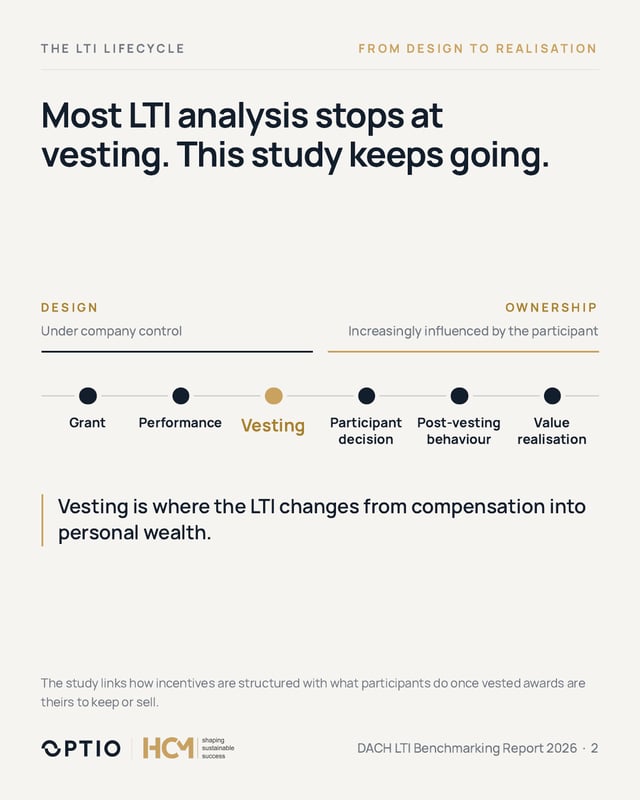
That gives the report three parts:
- Designing LTI: what shapes LTI design across DACH.
- Beyond vesting: what participants do once awards vest.
- Closing the loop: what this means for future LTI design.
What are the key findings?
Four findings from the report, with many more inside.
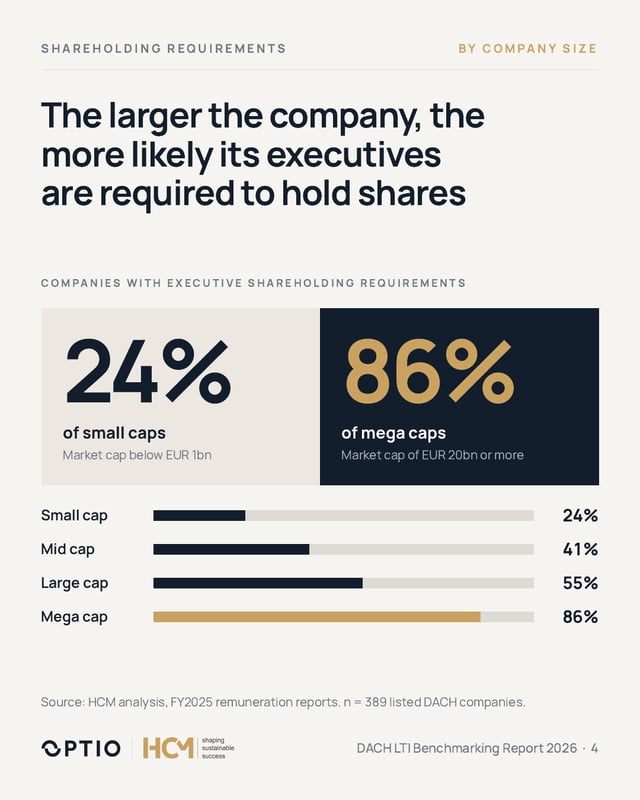
1. Shareholding requirements rise sharply with company size
86 percent of mega caps require their executives to hold shares. Among small caps it is 24 percent.
2. One performance measure is rarely enough
87 percent of companies with performance-conditioned LTI vesting use two or more KPIs. Three is the most common design.
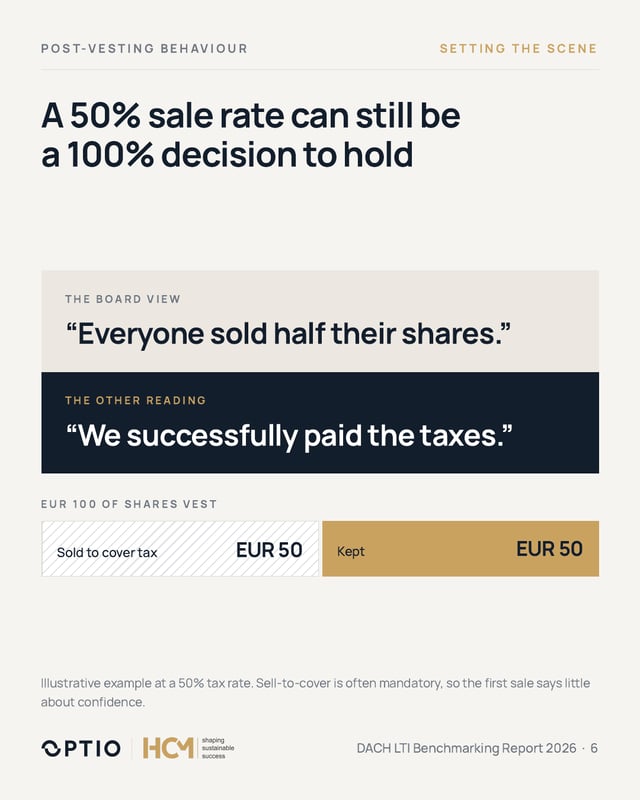
3. A 50 percent sale rate can still be a 100 percent decision to hold
When shares vest, a large part is often sold to cover tax. In an illustrative example at a 50 percent tax rate, a participant sells half the award and keeps every share they were free to keep.
4. Participants follow the share price
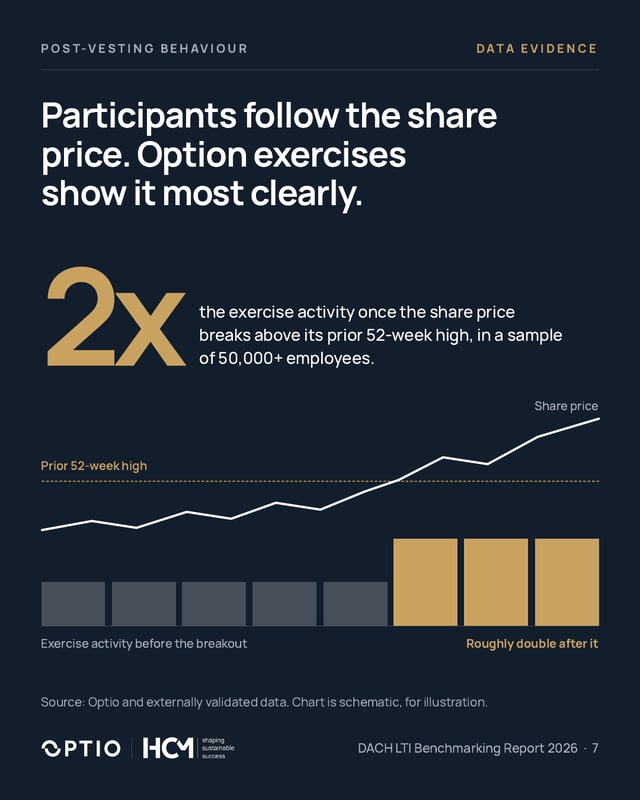
Option exercise activity roughly doubles when the share price breaks above its prior 52-week high, in a sample of more than 50,000 employees.
What is a good sell rate after vesting?
It is the question boards ask most, and the report answers it. You will find:
- A rule of thumb for a typical DACH listed company, drawn from Optio's plan experience.
- How the right figure shifts for stable dividend payers and for tech-style populations.
- A way to separate mandatory, constrained and discretionary selling, so you measure what participants chose to keep.
Get the answer in the full report
What is inside the full report?
- LTI prevalence and plan types
- Grant approach and grant sizes for CEOs and other executives
- Instrument choice and settlement
- Performance measures and ESG in the LTI
- Vesting type and vesting periods
- Caps and clawback
- Executive shareholding requirements
- Tax and liquidity mechanics at vesting
- Broad-based plans compared with executive LTIs
- Why participants sell and why they hold
Frequently asked questions
How many companies does the DACH LTI benchmarking report cover?
393 listed companies across Germany (DAX, MDAX and SDAX), Switzerland (SPI) and Austria (ATX Prime), based on FY2025 remuneration reports.
Who wrote the report?
It is a joint study from Optio and HCM, by Andreas Berner, Head of DACH at Optio, and Olga Beregova, Partner at HCM.
What is post-vesting behaviour?
It is what participants do with their shares after vesting, exercise or the end of a restriction period: how much they sell, how much they hold, and why.
Is the report free?
Yes. It is free to download.
Can someone walk me through the findings?
Yes. Grab 15 minutes with us, one to one, and we will go through the benchmarks most relevant to you.
Download the report
See where your plan sits against 393 listed companies, by market, sector and company size.
Download the 2026 DACH LTI benchmarking report
Prefer to talk it through one to one? Get in touch and we will take you through the data in 15 minutes.
The tax figures in this article are simplified illustrations. The report does not constitute legal, tax or remuneration advice.

 The Optio Team